
Journal · 05
GHK-Cu serum for the face: what human studies actually show
A close reading of the small randomized post-laser trial: measured outcomes, perceived skin quality and the limits of daily-serum claims.
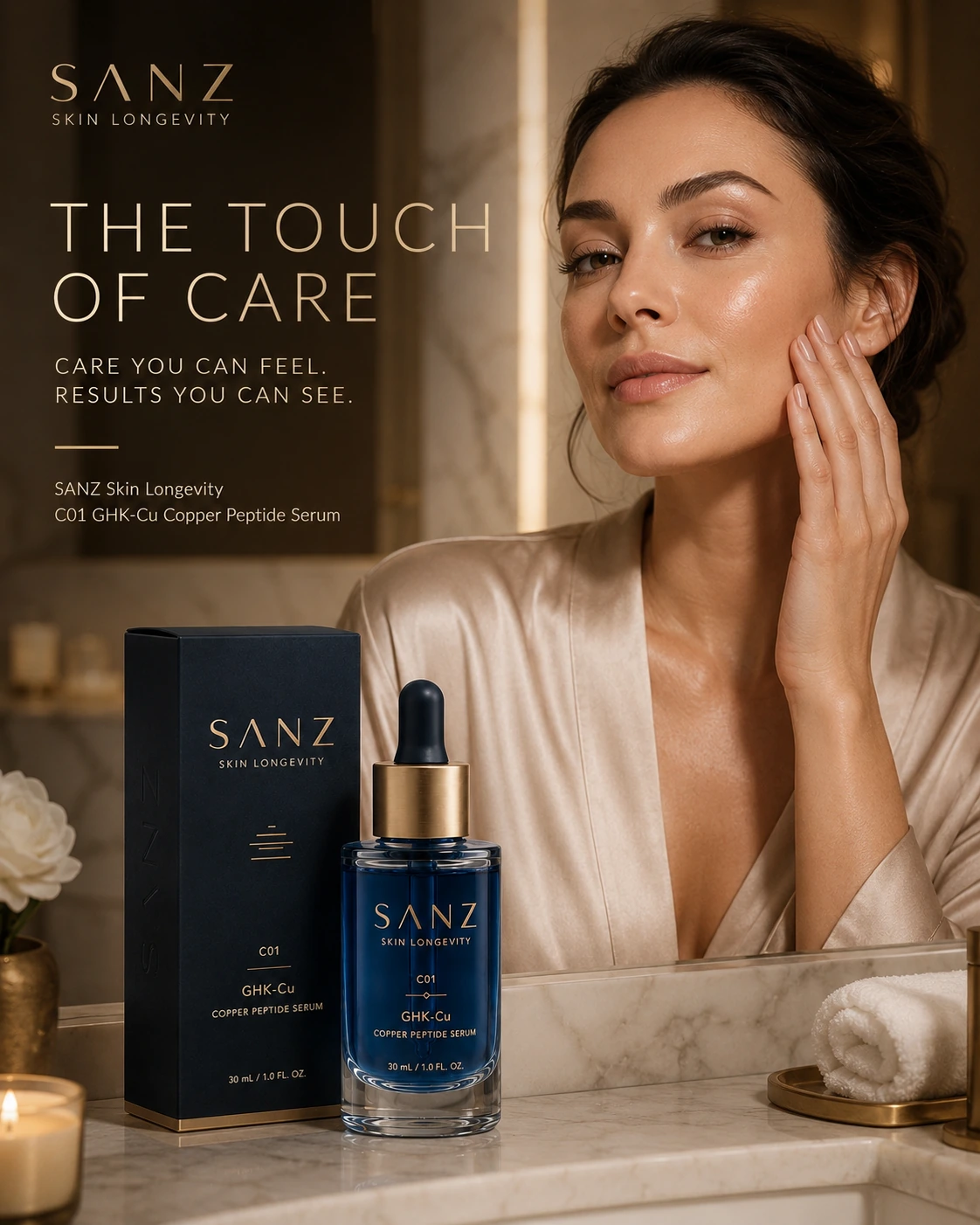
Human evidence for topical GHK-Cu is limited. In Miller’s 2006 randomized study after CO₂ laser resurfacing, 13 people completed follow-up. Objective assessments did not show statistically significant differences between regimens in redness, wrinkles or overall skin quality; a patient questionnaire favored the GHK-Cu group. These are different findings, not interchangeable proof of facial rejuvenation.
What the trial actually compared
Miller TR and colleagues studied circumoral skin that had undergone CO₂ laser resurfacing. Participants were randomized to posttreatment skincare regimens with or without a copper tripeptide complex. The comparison was therefore between care regimens after a procedure, not between C01 and a placebo on untreated facial skin.
That setting matters. Laser-treated skin has a different barrier and recovery context from intact skin in an everyday routine. A result in that setting cannot establish how a commercially available serum behaves when applied to an untreated face. The original paper’s title identifies this important boundary.
Objective results and perceived quality
Computer analysis and blinded evaluators found no statistically significant between-group difference in the resolution of erythema. At 12 weeks, wrinkles and overall skin quality improved in participants after resurfacing, but the objective comparison did not detect an additional benefit between the groups.
The validated patient questionnaire did find a difference in perceived improvement of overall skin quality favoring the GHK-Cu regimen, with P = .04. That is a reported subjective outcome. It should be presented alongside the objective findings, not retold as if instruments or blinded graders had demonstrated a wrinkle benefit.
“Perceived improvement and objective improvement are not the same result.”
What a small study cannot settle
Thirteen completers give a narrow evidence base. Failure to detect a statistically significant difference is not proof that an ingredient can never have an effect. Equally, a favorable questionnaire does not establish a general effect size, a cure or predictable results for every user.
A useful report keeps the sample, comparator, time point and outcome together. It also separates improvement following the shared laser procedure from any additional effect of the skincare regimen. Without that distinction, a reader may mistakenly assign the procedure’s results to a serum.
How to use this evidence when choosing a serum
Ask whether a claim concerns the ingredient or the exact finished product, and whether participants used it in a setting similar to yours. For daily facial use, a relevant finished-product study would need its own formulation, comparator, tolerability assessment and clearly described outcomes.
The 2025 review linked below notes the scarcity of topical clinical studies. It is secondary context, not a second trial confirming Miller. SANZ does not present these publications as clinical evidence for C01.
In closing
The most useful answer is a precise one: there is a small human study in a specific post-procedure setting, with a subjective signal but no demonstrated objective between-group advantage at 12 weeks. Read it as a reason for informed questions, not as a promise about a facial serum.
Further reading
- Miller TR et al. (2006). Effects of topical copper tripeptide complex on CO2 laser-resurfaced skin. Arch Facial Plast Surg 8:252–259. DOI: 10.1001/archfaci.8.4.252 · Randomized human study after CO₂ laser
- GHK and derivatives: topical evidence and permeability review (2025) · Secondary review — not a trial