
Journal · 07
Does GHK-Cu penetrate skin? Reading the studies carefully
Isolated skin, copper measurements and microneedle pretreatment answer different delivery questions—not whether every serum absorbs.
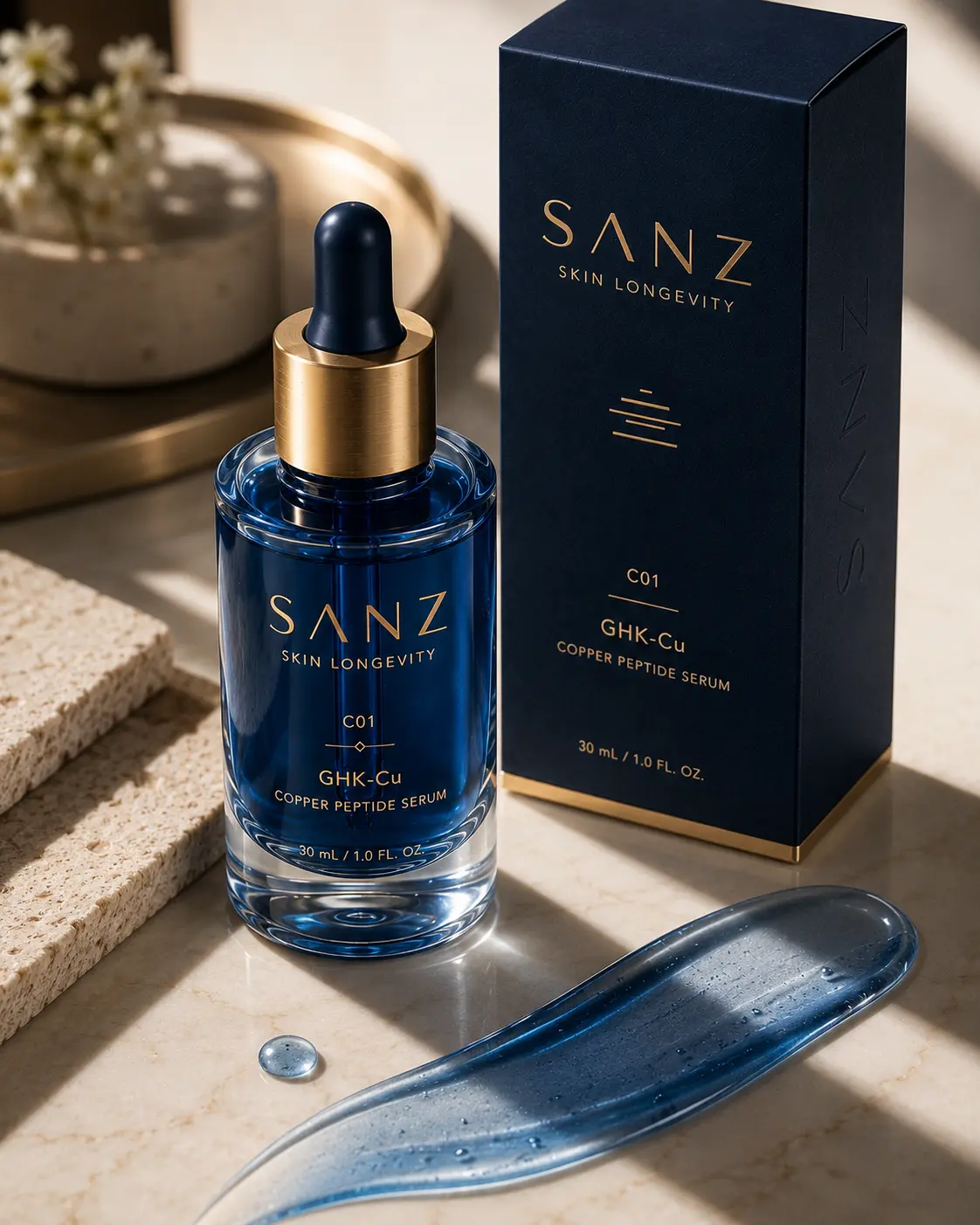
Some laboratory studies detect copper or peptide-related permeation under specific conditions. They do not show that any GHK-Cu serum reliably delivers intact complex into a living face. The 2010 isolated-skin study measured copper; the 2015 microneedle experiment changed the skin barrier before testing delivery.
The 2010 experiment: layers and exposure
The 2010 paper used isolated human skin layers in diffusion cells, including stratum corneum, separated epidermis and dermatomed skin. Researchers applied an aqueous copper-tripeptide solution at 0.68 percent under infinite-dose conditions and collected receptor fluid over 48 hours.
The exposure model was designed to study retention and passage across tissue layers. It was not an everyday finite application of a cosmetic serum to volunteers. Layer preparation, the vehicle, duration and amount available at the surface all affect how directly a result can be transferred to normal use.
Copper detected is not intact complex demonstrated
The analytical method quantified copper in tissue and receptor fluid. Copper can be a useful marker, but detecting that element does not by itself establish the identity or amount of intact GHK-Cu complex at a target site. The paper’s measurements should be named accurately.
Penetration and efficacy are also separate questions. Even a well-characterized delivery result would not alone show a visible facial benefit, tolerability during repeated use or the behavior of a different commercial formula. The studied solution’s concentration is not a documented specification for C01.
“Name what crossed the tissue—and what the assay actually measured.”
What Li’s 2015 microneedle study changed
Li H and colleagues used polymeric microneedles to pretreat skin and assessed delivery in in-vitro human skin models, with cellular and porcine models for safety evaluation. Permeation increased compared with intact skin in that experiment. The microneedles created microconduits: the barrier was deliberately altered.
This is not evidence that an ordinary serum achieves the same delivery through intact skin. The experimental safety observations do not establish safety for a home procedure or repeated use on a living face. SANZ does not recommend home microneedling, and C01 is not described as using this technology.
Questions worth asking about a delivery claim
Identify the species and tissue preparation, whether the skin was intact, what vehicle was used, how long exposure lasted and what the assay actually measured. Then ask whether the exact finished product was tested. “Human skin” can describe isolated tissue, not a clinical trial in human volunteers.
A review can map these delivery challenges but cannot erase differences between models. Read the primary papers alongside the review’s context. A claim that all copper peptides penetrate alike overlooks both chemical identity and formulation; evidence about another copper or zinc compound is not a substitute.
In closing
The defensible answer is conditional: delivery has been investigated in particular laboratory models, with distinct barriers and measurements. A retail serum needs its own relevant evidence. Do not turn a diffusion-cell result into a home procedure or a universal absorption promise.
Further reading
- Human skin penetration of a copper tripeptide in vitro as a function of skin layer (2010 online / 2011 volume) · Isolated human skin, in vitro
- Li H et al. (2015). Microneedle-Mediated Delivery of Copper Peptide Through Skin. Pharm Res 32:2678–2689 · In-vitro human skin; porcine/cellular models
- GHK and derivatives: topical evidence and permeability review (2025) · Secondary review — not a trial